

I was going through recent art suggestions this morning — I learned a long time ago to check that the titles and artists are correct — and this was one of them: The Flower Market by Edouard-Leon Cortes (or Marche aux Fleurs). 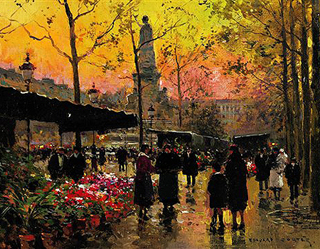 You may have seen this in the news recently. Someone left it at a Goodwill in Maryland, where the staff would normally price something like this at about $100. However, they noticed that it had an old frame and a brass plaque and checked with Sotheby’s and discovered it was valuable. It later sold at auction for $40,000. Amazing. Things like that are always turning up on Antiques Roadshow — someone brings in a painting that their mother bought at a thrift store for $1 and it turns out to be by an obscure (to me) but highly collectible artist. The question is, why doesn’t it happen to me? When I go to the Blue Hanger all I see is awful trash. There’s apparently a knack (and it probably requires a lot more time at thrift stores than I want to spend).
As a friend of mine likes to say, there are two kinds of people — in this case, people who are comfortable ordering over the Internet, and people who aren’t. There are also two kinds of people who ARE comfortable ordering over the Internet, and one of them is the kind of person who is SO comfortable that they don’t pay any attention to what they’re ordering. Yep, yet another person who thought they were ordering an art print. As he pointed out, it said “large print” so he went for it. Of course right above that it said “pattern” and just to the right of that it said “Counted cross stitch chart (floss and fabric not included)” and above that it said “cross stitch” three different places. The “floss and fabric not included” language has cut down fairly well on the number of orders from people who thought they were buying a painted needlepoint canvas or stamped cross stitch or a kit, but I’m still not reaching everybody.
Some people say there should be a statement on the checkout page like this: “I understand I am buying a counted cross stitch chart booklet” and a button “I agree” that they have to click, but I hate to do anything with quite so much attitude, and besides, having missed the four places on the pattern page where it says “cross stitch” what are the chances they’ll read this last one? Meanwhile it’s insulting to the people who are paying attention. There must be some other way. It needs to be obvious but subtle and clear without talking down and fit within the current page layout. That should be easy!
BTW, he can of course return the pattern and I hope he does. Sometimes people who have gotten off into the tall grass ask if they can return the pattern but never do. I suppose they decide it was their mistake and they must pay for it, but I would rather not leave unhappy people hanging out there. I probably already have more negative karma than I can burn off in this lifetime.
I’ve been working on a new hummingbird pattern, a detail of the Columbian hummingbird pattern (AUD002), in the ongoing quest to have more small patterns. I approached it by taking the existing pattern and removing all but one hummingbird, flower, and few leaves and a piece of stem. Much to my chagrin, that little section uses ALL the colors of the larger pattern. I did manage to reduce the colors some, but it still uses a LOT of colors for what will be (I think) our smallest pattern yet.
As I worked on the pattern, thinking about hummingbirds going after nectar, I realized that I don’t actually know how flowers produce nectar, or which ones have a lot of nectar. (The only nectar flower I’m familiar with is Japanese honeysuckle — as kids, we used to pick the flowers, pinch off the base, and suck the nectar. Yummy!) I thought hummingbirds were primarily attracted to red, tube-shaped flowers. Maybe it’s the color more than the shape — I sometimes see hummingbirds checking out our orange cannas, which they apparently find to be a big disappointment.
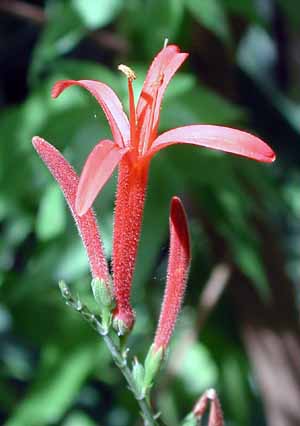
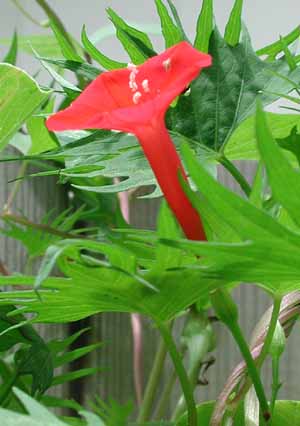
Right outside my window is a hummingbird feeder and a flame acanthus, which just started started to bloom. The hummingbirds have been visiting the acanthus flowers and it’s cool to see them actually put their beaks all the way into the flowers, but they always seem to decide it’s too much work and go back to the feeder. The quamoclits are starting to bloom, finally, but they apparently are not good hummingbird flowers. The flame acanthus is a native plant, so maybe that has something to do with it. Here they are, flame acanthus on the left, quamoclit on the right. Both flowers are about an inch long (2.5 cm).
We were visited by a family of racoons last night about 4 AM. As usual, the cats gave the “intruder alert” by scratching at the window panes and huffing loudly. There were 2 adults and 3 young racoons. I don’t know if they were just shopping or if they had come to clean up the remnants of cracked corn I had put out for the white-winged doves.
(We have a squirrel- and heavy-bird-proof feeder — there is a counter-weighted perch which closes the metal feeder when anything heavier than your specified weight lands. I love to watch the birds but feeding the doves gets to be a bit much. There are a lot of them (sometimes we’ve had 40 at once on our deck) and they are big and they eat a lot. So I’ve excluded them from the feeder, but sometimes I feel sorry for them — they see the other birds getting food from the feeder and they just can’t figure out why they can’t get anything. So sometimes I give in and give them a little food on the deck.)
The adult coons moved on pretty quickly, but the youngsters stayed to wash their hands in a shallow pan of water I keep on the deck for the birds. Then they began trying to duck each other in it. Very cute. But you should have seen the sludge in the previously clean water — how do they get so dirty?
Anyway it was fun to see — like being at a Davy Crockett convention!
I have taken up work on the fruit crate label again. It’s amazing how BIG 18-count stitches seem after working on the 22-count Ariosa. And how stiff and scratchy the aida seems. I have been stitching on nothing but 18-count aida for about 6 years and I got unused to it in only a couple of weeks.
I just got an email from our local needlework shop that they are having a framing sale in 2 weeks. Can I finish this by then? I’m maybe 1/2 to 2/3 done. I really doubt it.
On a recent Antiques Roadshow, a guy had a whole lot of orange crate labels — brand new, unused. They were so beautiful. Some were salesmen’s samples, with just the art work. Apparently printer’s reps would visit growers and show them these templates for labels, and the grower could pick a picture that went with their brand, or maybe think up a brand that went with a picture they liked, and they’d add the appropriate text. Afterwards I checked on eBay and there are a lot available there. I really like orange crate labels. Must … not … bid … I mean I could, they’re not expensive, but I have too much stuff already, and I need what little wallspace is left for needlework. 🙂
I have been drooling over a great Art Nouveau ABC in blackwork for over a year. I saw it in the Online Needlework Show and loved it but it was priced per letter and was pretty expensive for the whole thing. This spring there was a new price for the whole alphabet and I snapped it up! It’s by Dessins DHC in France. They seem to do a lot of blackwork in France and a lot of it is lovely. I’ve never done blackwork before and wanted to try it. You can see the whole alphabet here.
Here’s my progress so far:
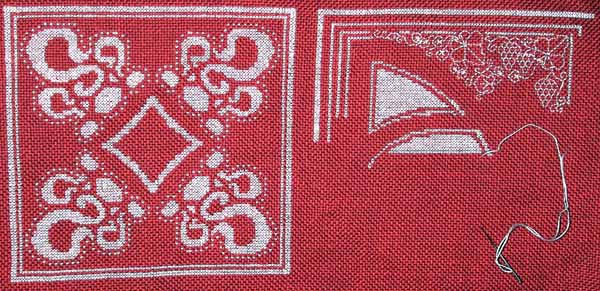
I took this along to Tennessee since my former travel project is now on a scroll frame. Although it’s a big piece of fabric, I figured that since there are no color changes it was simple enough to do in the car. I’m stitching it on Victorian Red Ariosa Fine which is a 22-count blend of 63% cotton, 37% rayon. I had a time figuring out how much fabric I needed because the chart specs were very confusing. It says it was done on 11-count black aida and came out to 18 cm on a side (per square). If it was really done on 11-count fabric, the squares should be about 9 inches which is about 23 cm. I finally decided that they don’t know how many centimeters there are in an inch. However, somewhere along the line I also decided that the squares are 96 stitches on a side. There are really 100, but the 10s lines are not very pronounced, and they gratuitously added 2 rows of blank squares around the edges of the chart. Naturally I didn’t realize this until after I had cut the piece of fabric I ordered, marked the starting point, and started stitching. So instead of having 3″ borders I was going to have a 3″ border on the left and a 2″ border on the right. But not to worry, I changed my spacing between squares from 10 threads to 8 and decided that I will finish it as a banner rather than framing it, so I don’t need very much on the sides anyway.
Way back before I got the fabric, I experimented on a piece of 22-count fabric I had and decided not to do the crosses with 2 threads as specified. You can stitch with 2 strands but it completely covers the fabric and I actually liked the effect of 1 strand which lets you see the x’s (if you look closely enough). Of course I forgot all this by the time I got started stitching, but now I’m on track and doing everything (x’s and top-stitching) with one thread. It’s a little tricky because stitching over 1, there is a tendency for the floss to slip along the fabric threads. To make the x’s behave, I’m completing them as I go. For the top-stitching, I just have to be careful and not pull the floss too tight.
If you wonder how I could see to do this in the car, mostly I couldn’t. I really need a magnifier even for normal-sized stitching. My glasses don’t let me focus close enough to see so I just take them off and stitch with my nose. But the interstates are not as smooth as they ought to be, so this worked better when we were visiting and I was not being bumped up and down.
It goes pretty fast — this is about 2 weeks worth of progress and I have used almost one skein of white floss. You don’t have to refer to the chart all that often, but some of the squares are almost solid stitching so I really have no idea how long it will take. I plan to put this aside and go back to the fruit crate label when I get to the end of the first skein.
We just got back from a trip to east Tennessee. I have relatives there and it has been a while since we visited. When I was a kid, we used to go to Tennessee almost every summer, but we lived a lot closer then. It’s a 16-hour drive from Texas. Of course the big attraction in east Tennessee (besides my relatives) is the Great Smoky Mountains. This time of year the woods are full of rhododendrons.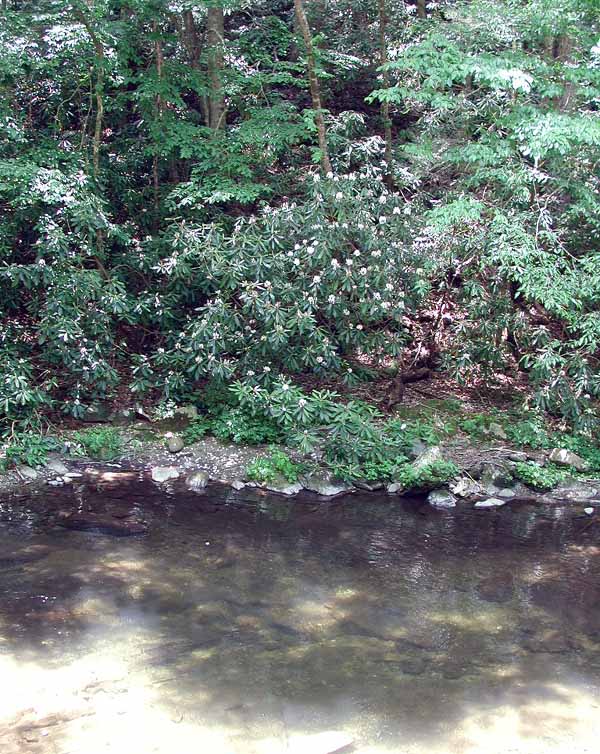
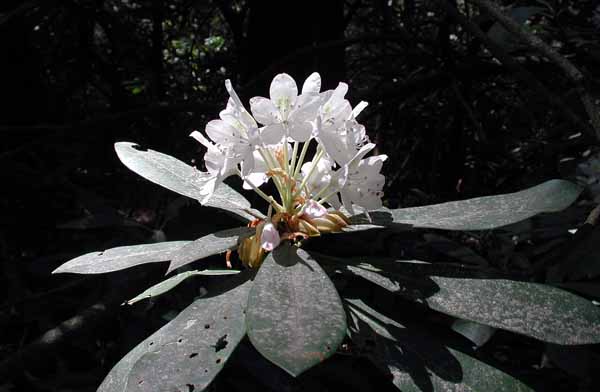
You see a lot more different flowers in late April or early May but the rhododendrons are really spectacular. These were on the Parsons Branch road, a one-way drive through the woods. We did see this terrific milkweed in Cades Cove: 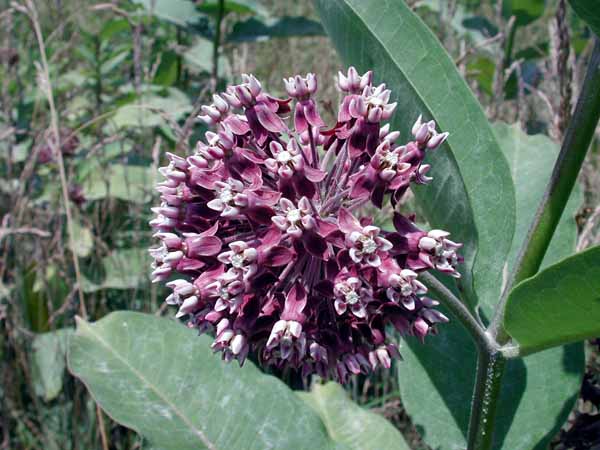
I think it is common milkweed, or Asclepias syriaca. It has a lovely grapey fragrance.
Cades Cove is often a good place to see wildlife. Although it was the middle of the day (not the best time for critters) we did see a black bear far off browsing the berries, and a white-tailed deer with a tiny fawn. The fawn could barely see over the tall grass and traveled in a series of leaps trying to keep up with its mother. I can see deer almost any time in my front yard snacking on my flowers and shrubs but fawns are adorable. It’s a shame they grow up into eating machines.
We also drove along the “Dragon Tail” (Route 129) which is a very winding road which follows the Little Tennessee River to Fontana Dam. Of course the Smokies are full of hydroelectric dams. This is Calderwood Dam which is the smallest one I’ve seen in Tennessee:
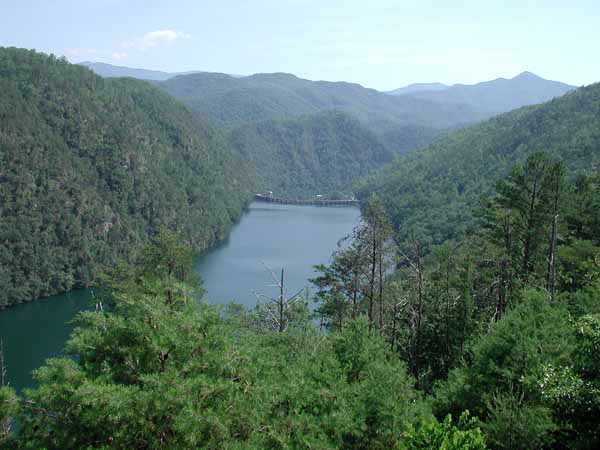
You have to be out early in the morning, usually, to see the mist that gives the Smokies their name. The haze in this picture is mostly an indication that I need a UV filter.
My gourd flowers turned out to be white, not yellow, and petals are separate instead of joined as I expected. For quite a while I kept wondering when I was ever going to see a flower — there would be buds in the afternoon but in the morning the flower was already shriveled up. I finally discovered that these gourds are blooming at night and the flowers don’t open until it’s fully dark.
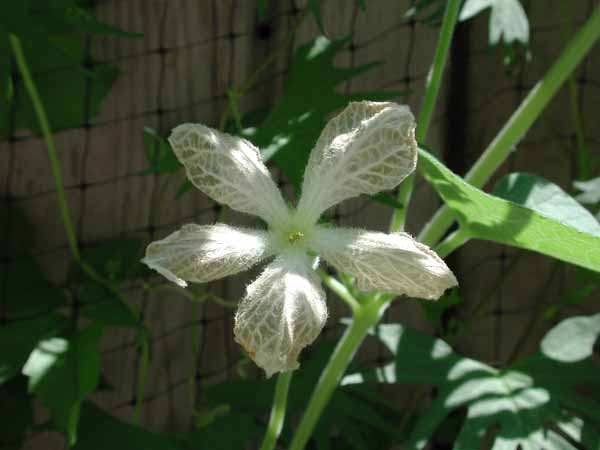
Here’s a picture taken at about 10 AM and the flower is looking pretty tired, although you can see that the flower is downy, which is neat! I tried to take some pictures of a fresh flower last night at 10 PM but I couldn’t see anything in the view finder at all so I got pictures of the top half of a flower, left half, etc. and mostly overexposed.
I looked up Cucurbita pepo and it turns out that practically everything falls into that species — zucchini, pumpkins, acorn squash, summer squash, spaghetti squash, etc. etc. but they all should have yellow flowers. I feel as if the botanists have not made a serious effort to differentiate these plants. It doesn’t seem right that squash with edible shells and squash with hard shells are the same species. I found the packet for the little warty ornamental gourds I’ve planted before but the top of the envelope is torn off so if it ever said what species they supposedly are that information is gone. But I believe what I actually have this year is Lagenaria siceria, which is a white-flowered bottle gourd blooming in the evenings. Fooey. I would have bought them anyway because they were the only gourd seeds I could find locally, but I was hoping for yellow flowers. And, need I say, flowers I didn’t have to use a flashlight to see.
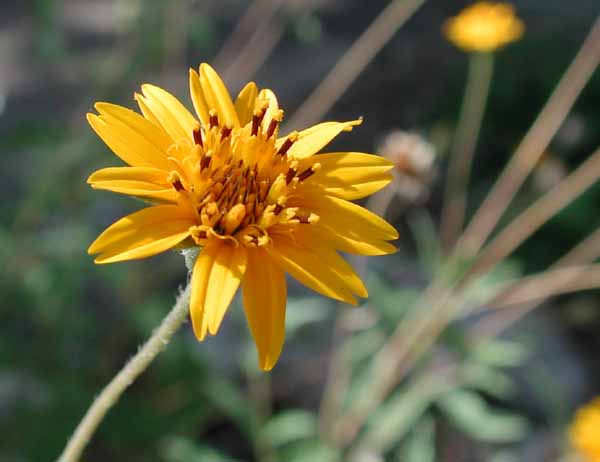
Yesterday as I was driving out I saw a small dark bird hovering over the xeriscape bed in the berm between the street and sidewalk. At first I thought it was a hummingbird, but it was too dark — we only have rubythroats here (as far as I know). I stopped to get a good look at it and it turned out to be a male lesser goldfinch picking seeds out of the gone-by zexmenia flowers (Wedelia hispida). Very cool! You can see a picture of the bird here. The closest I’ve seen them is 3 hours southwest, in the Uvalde area. I hope it will be a regular visitor to the zexmenia, although I’ve never heard of goldfinches eating anything but thistle seed. Maybe it will make do with zexmenia seeds until the thistles have bloomed and gone to seed.
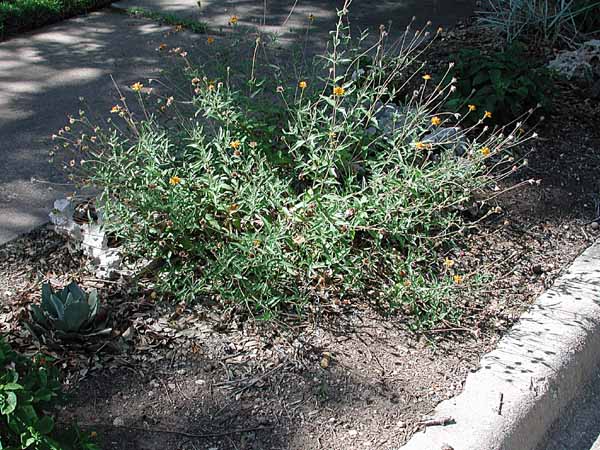
We have planted the berm with various drought- and deer-tolerant plants. The zexmenia has nice flowers but it’s a weedy, woody kind of plant with rough-bristly leaves and stems (that’s what hispida means). The best thing is that the deer leave it strictly alone and can’t hurt it even when they go crashing clumsily through it. (They keep knocking pads off the prickly pear. Fortunately the pads root readily if you stick them in the ground but I’d rather have one large prickly pear than 10 small ones.)
I still don’t know if I have succeeded in reaching the M. C. Escher people. I sent another fax asking them to email me about whether they got the first fax or not (and if I am reaching someone other than the Escher company, to email me anyway). So far, nothing. But in the mean time, I remembered this old thing, “All is Vanity” and thought it would be a good test for a black-and-white chart.

I used to see it often at flea markets and antique shops. It’s a lady looking at herself in the mirror but the overall effect is of a skull. It must have been very popular at one time but I’m not sure whether people took it as a moral comment on vanity or if they thought it was funny.
The artist drew it in 1892 when he was 19, and went on to have a fine career as an illustrator but this is his most famous work. How sad to peak at 19, or for people to think you did!
 I am speechless! I'm a 36 year old man who learned to cross stitch from my mom and grandfather, who both loved the craft. I have been looking for years for fine-detailed patterns for cross stitching and have not found much at all, until I found this website (by accident, even!) - I'll br purchasing my first pattern this evening. I'm sure I'll be back often.


